I love Jester, its exactly what we needed from a new UK hop. It brings some of the flavours I love in new world hops like grapefruit and gooseberry, but it does it in its own way.
Fergus Fitzgerald, Head Brewer, Adnams
Growing hops is one of the hardest crop choices in farming. Hops require a high attention to detail throughout the year but most especially in the growing months as they need to be checked weekly, sometimes more often. Hop growers are resilient folk and often grow other horticultural crops, particularly apples.
Growing organic hops in the UK presents quite a challenge. The first thing you notice is that our hop yards tend to be full of weeds. These are both good and bad. On the one hand they compete with the hops for nutrients and moisture so significantly reducing yield potential. On the other hand, the weeds give a diversity of habitat where beneficial insects such as aphid and red spider eating predators can live. We rely on keeping the plants as healthy as possible and to do this we keep the soil in as good a condition as we can and do not encourage excessive growth in the plant. Despite this we are entirely at the mercy of the season and yields vary accordingly, most notably on the number and timing of the Damson Hop aphid.
March, April, May & June:
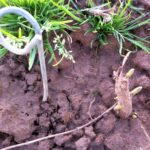
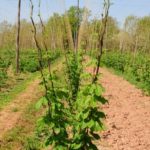
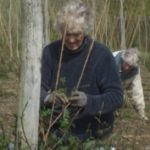
The hop plant is perennial and grows back from the rootstock every year. Depending on the warmth of the Spring, this usually starts in early April when the first shoots start to emerge.
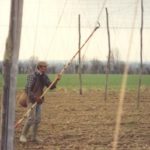
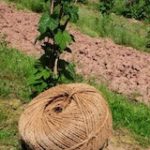
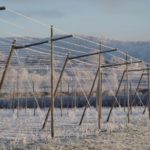
The ‘stringing’ of tall hop yards and hop gardens starts in March. In fact, some farmers use the winter to complete the job slowly. Natural Coir string is used to create the framework for the hops to climb, supported by the permanent structure of the poles and wirework. The stringing is done by hand with the aid of a long pole called a ‘monkey’ and is taken from the permanent ‘peg’ in the ground up to the hooks on the top wirework above, up to 6 metres off the ground. Various patterns of stringing have been devised to optimise yield and ease harvesting, depending on variety and region.
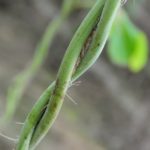
From April onwards, the hops are ‘tied/twiddled’ or trained onto each string. Depending on the variety either two or three shoots are tied, clockwise, to each string. If they are tied anti-clockwise, they will fall off. If we have a windy spring, the hops may need to be re-tied several times. Again, this is all completed by hand.
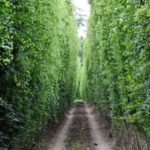
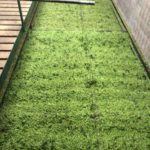
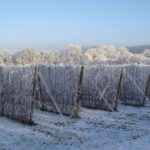
In a Hedgerow hop yard or garden, the Spring is the time that the previous year’s old growth (strig) is removed using a front-mounted rubber flail. The hedgerow hops self-train onto the UV stable polypropylene netted structure, significantly reducing the hand-labour requirement. The netting is designed to last for up to 7 years.
In the Spring, proactive spray programmes commence. Hops are monitored regularly by walking the crop, any irregularities can then be dealt with. For more information about the UK’s pests and diseases, click here.
By June, the plants are starting to establish on the strings or netting.
July & August:
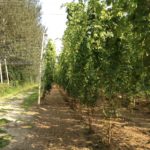
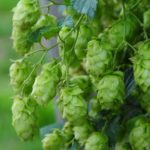
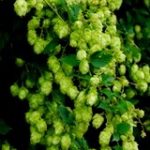
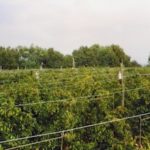

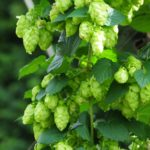
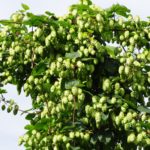
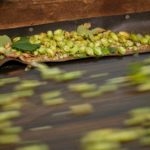
By the middle to end of July, the hops should have reached their full height and the laterals begin to grow out. Hops come into ‘burr’ first and then the flower or cone develops. It is the shortening of the day length/daylight hours that triggers the plant to produce burr and flower. Broadly speaking, the plant is 3 weeks in burr and 3 weeks in hop before reaching maturity.
It is during these 2 months that the growers need to be very vigilant to ensure the crop is disease free. Should a disease or pest be allowed adequate time to do damage, the crop may not recover – this may be only a matter of days.
September:
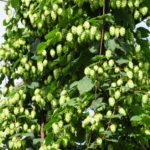
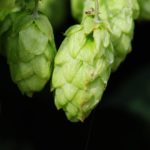
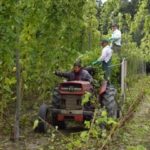
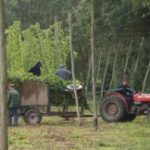
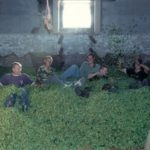
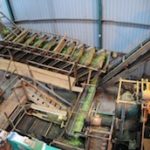
The UK harvest usually starts in early September and depending on varieties grown and size of farm, it may continue into early October. Tall hops are harvested by cutting the whole bine including string and taking it to the hop picking machine where the hop is separated from the bine, laterals and leaf.
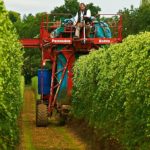
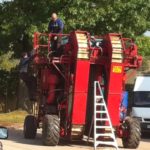
Hedgerow hops are harvested mechanically using a machine developed from the British blackcurrant harvester. The hop and leaf is taken to the hop picking machine where the hop is separated from the leaf. For a video of the British Hop harvest, click here. For more photos on the Hop Harvest, click here.
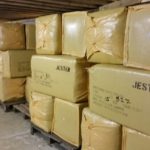
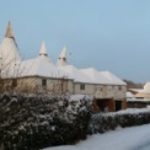
Arguably the most important aspect of hop farming is the drying. Once clean of the leaf, the hops are distributed into baskets and put into the hop kiln or oast to dry. Hops contain over 80% moisture when picked and in order to make them store, this is reduced to about 10%. They are then baled into bales of 60kg in weight.
To help preserve the hops, they can be stored in a cold store and baled for 1 year; if vacuum packed, they can be cold stored for 2 years; if pelleted, they can be vacuum packed and cold stored for 5 years.
October & November:
Once picked, the tall hop yard and gardens require the bines to be cut to the ground and disposed of which we call ‘bine-cutting’. At the end of the season, depending on the weather and levels of soil compaction, hop yards and gardens may be improved by subsoiling and/or shakerating the rows.
Winter Months:
During the dormant period, growers complete a range of jobs including: wirework and pole maintenance; liming the soil to provide the right ph balance; slug control and ‘gapping up’ of dead or diseased plants.
I love Jester, its exactly what we needed from a new UK hop. It brings some of the flavours I love in new world hops like grapefruit and gooseberry, but it does it in its own way.
Fergus Fitzgerald, Head Brewer, Adnams